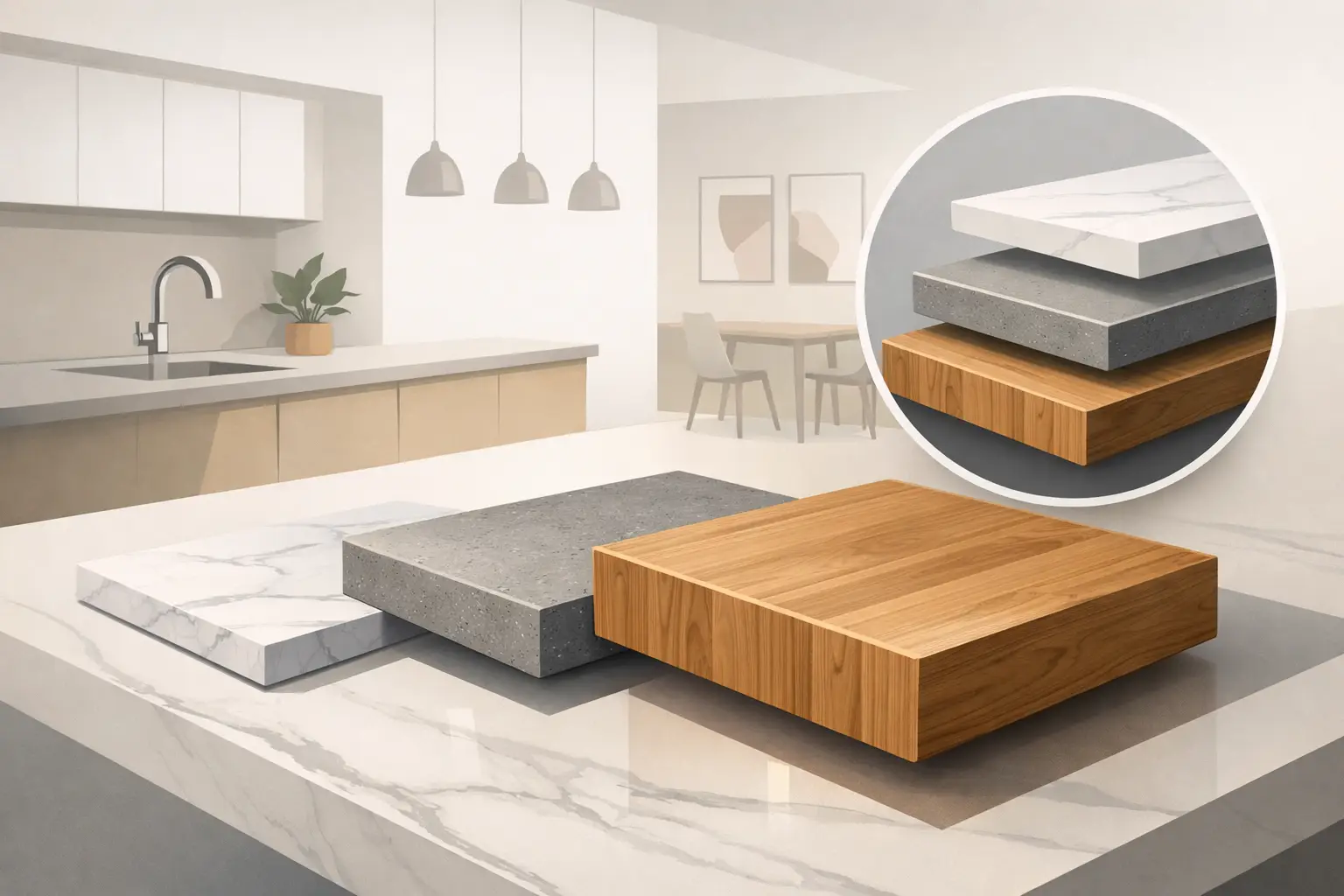
A countertop can look substantial without feeling heavy, or disappear into a room despite being made from a remarkable material. The difference often comes down to proportion. Knowing how to choose countertop thickness means considering more than a measurement: it is about the material itself, the scale of the room, the edge detail, and the way the surface will be used every day.
For a tailored kitchen island, a restaurant bar, or a live-edge dining table, thickness helps define the character of the finished piece. A slim profile can feel crisp and contemporary. A deeper slab or built-up edge can bring warmth, permanence, and architectural presence.
Start With the Visual Weight You Want
Thickness is one of the first details the eye reads. In a light-filled, minimalist kitchen, a thin stainless steel or specialty glass top can keep cabinetry and fixtures feeling clean-lined. In a traditional home with substantial millwork, a thicker wood countertop may feel more natural and appropriately scaled.
The size of the surface matters just as much. A 30-inch bathroom vanity does not need the same visual mass as a 10-foot island or a long commercial bar. Large surfaces generally benefit from more depth at the edge, whether that comes from the material itself or from a carefully crafted built-up profile.
Consider what the countertop sits beside. Thick exposed beams, oversized range hoods, paneled cabinetry, and wide-plank flooring can support a bolder surface. In a smaller room with delicate cabinetry, a thick top may become the dominant feature. That can be beautiful when intentional, but it should not happen by accident.
How to Choose Countertop Thickness by Material
There is no universal best thickness. Wood, metal, engineered concrete, and glass each have different structural characteristics, fabrication methods, and visual strengths. The right specification begins with the material rather than a one-size-fits-all rule.
Wood countertops and butcher block
Wood is especially expressive at a thicker dimension because its end grain, edge grain, or wide-plank construction becomes part of the design. Many wood countertops are made at approximately 1 1/2 inches thick, a versatile proportion for kitchen counters, islands, and work surfaces. It offers a substantial feel without appearing overly heavy in most homes.
For a large island, freestanding table, or dramatic waterfall-style design, 2 inches or more can create a stronger statement. Thick wood also gives more room for shaped edges, hand-softened details, and the visual richness of live-edge slabs.
A thinner wood profile can be appropriate for a refined table or a more contemporary setting, but it requires careful consideration of span, support, and intended use. Long unsupported runs or surfaces that will carry significant weight may call for a more substantial construction.
Wood also changes naturally with its environment. Thoughtful fabrication and a durable protective finish are essential, particularly around sinks, beverage stations, and high-use kitchen zones. Brooks Custom’s Marine Finish is designed for selected wood surfaces that need lasting protection while preserving the warmth and character of real wood.
Metal countertops and bar tops
Metal can achieve a slender, elegant profile because the visible surface is often formed over a stable substrate. Zinc, pewter, copper, bronze, and stainless steel can be fabricated to create a clean edge, a wrapped profile, or a deeper-looking built-up edge.
That flexibility makes metal especially useful when you want thickness to be a design choice rather than simply a material limitation. A slim stainless surface may suit a modern kitchen or service counter. A thicker-looking zinc or antique bronze bar top can lend a hospitality space the patina and permanence of a long-established gathering place.
Ask to see the edge construction, not just the top view. The profile determines whether the surface reads as fine and tailored, softly traditional, or boldly architectural. It also affects how comfortably guests can sit at a bar and how the top meets adjacent woodwork or cabinetry.
Engineered concrete
Engineered concrete offers the look of a weighty, monolithic surface while allowing more flexibility than a conventional poured slab. It can be fabricated in a range of dimensions and finishes, from sleek and restrained to deeply substantial.
A thicker engineered concrete countertop works well when the room calls for sculptural presence: a generous island, an outdoor entertaining surface, or a commercial counter designed to anchor the room. In a compact kitchen, a more refined profile can retain concrete’s tactile appeal without making the space feel dense.
Because engineered concrete specifications depend on the particular piece, including its size, shape, and support conditions, thickness should be decided as part of the complete design rather than selected from a standard chart.
Specialty glass
Glass countertops bring lightness that other materials cannot replicate. Thickness influences not only the strength and feel of the top, but also the way light travels through its edge. A thicker glass edge can create remarkable depth, color, and luminosity, particularly when paired with underlighting or a dramatic bar setting.
For a kitchen, vanity, or tabletop, the appropriate glass thickness depends on the dimensions, edge treatment, and how the surface will be used. A slender appearance may still involve carefully engineered fabrication. The goal is a piece that feels visually effortless while meeting the practical demands of the setting.
Match the Edge Profile to the Thickness
The edge is where a countertop reveals its construction. Two tops with the same overall measurement can look entirely different depending on whether the edge is square, eased, layered, mitered, or organically shaped.
A square edge emphasizes clean geometry and often makes a top feel thinner and more contemporary. A gently eased edge softens the look and feels comfortable in everyday use. A built-up or mitered edge creates the appearance of greater thickness, allowing a surface to have dramatic visual depth without requiring the entire piece to be solid at that dimension.
For live-edge wood, the natural contour is the edge detail. Here, additional thickness can highlight the grain, movement, and history of the slab. The effect is less about a precise number and more about preserving a proportion that feels honest to the material.
When reviewing samples, look at them from the side as well as from above. A material’s color, texture, and reflective quality often change at the edge. This is particularly true of metal, glass, and richly figured wood.
Think About Use Before Choosing a Dramatic Profile
A family kitchen island, a cocktail bar, and a decorative console table ask different things of a surface. Thickness should support the daily experience, not only the first impression.
At a kitchen island, consider seating, overhangs, appliance clearances, and the relationship between the top and surrounding cabinetry. A thick edge can make an island feel grounded, but it may also reduce knee room where stools are planned. A more restrained profile can preserve a lighter, more open feeling.
For bar tops, a deeper edge often adds the presence guests expect from a hospitality setting. It can also create a satisfying place to rest an arm or lean during a conversation. Material matters here: a softly patinated zinc bar and a polished wood bar may share a similar depth while delivering completely different experiences.
In bathrooms, thickness should be balanced against the scale of the vanity and fixtures. A thick wood or concrete top can be striking in a powder room, where a compact footprint benefits from one memorable element. In a primary bath with a long run of cabinetry, a slimmer profile may keep the room serene and spacious.
Tabletops require another layer of consideration. A substantial dining table can become an heirloom focal point, but a top that is too thick for its base may feel top-heavy. The dimensions of the legs or pedestal should visually answer the weight of the surface above.
Let Support and Dimensions Inform the Decision
The longest span is often more significant than the room size. A thick-looking surface is not automatically better suited to a long overhang, and a thinner profile is not automatically inadequate. Material construction, reinforcement, the underlying support, and the details of the finished piece all work together.
This is where custom fabrication offers a real advantage. Rather than forcing a design into a limited set of stock sizes, you can develop a proportion that fits the actual length, depth, use, and material character of the project. A 1 1/2-inch wood island may be exactly right in one space, while another calls for a 2-inch statement edge or a refined metal profile.
Bring cabinet drawings, room dimensions, material samples, and photographs of adjacent finishes into the conversation. Seeing wood tones, metal fixtures, tile, paint, and hardware together makes it easier to judge whether the countertop should lead the room or quietly support it.
The most successful thickness is rarely the thickest or the thinnest option. It is the one that makes the material feel intentional, the room feel balanced, and every use of the surface feel considered. When those details align, a custom countertop becomes more than a work surface – it becomes the element that gives the entire space its point of view.