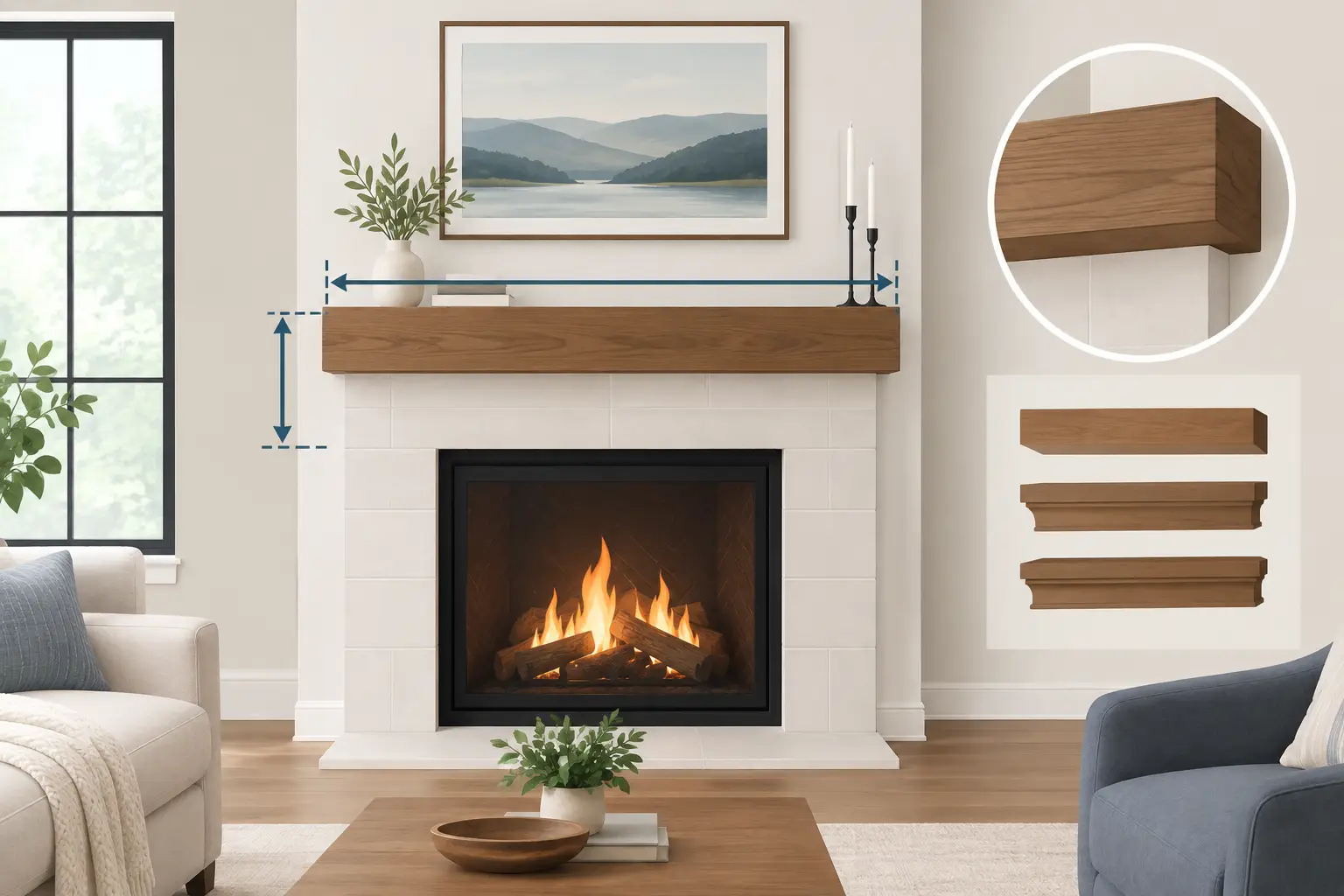
A mantel can make a fireplace feel generously proportioned, quietly tailored, or oddly undersized in an otherwise beautiful room. Knowing how to size a fireplace mantel begins with looking beyond the firebox itself. The best dimensions respond to the full composition: the opening, surround, chimney breast, ceiling height, furnishings, and the visual weight of the material you choose.
A custom mantel is not governed by one universal formula. A wide-plank oak slab, a dark patinated metal shelf, and a substantial cast-concrete mantel may share the same measurements yet create entirely different effects. The goal is to establish a focal point that feels intentional and made for the architecture around it.
Start With the Fireplace, Not the Mantel
Measure the visible fireplace opening first, then measure the surround and the wall area that frames it. The opening is your reference point, but the surround usually has greater influence on the final mantel width. A mantel that aligns with the outer edges of a stone, tile, metal, or plaster surround often feels more resolved than one sized only to the firebox.
For a fireplace with a simple surround, the mantel commonly extends beyond each side of the opening. This overhang gives the piece presence and creates a practical ledge for art, objects, or seasonal styling. On a broader chimney breast, a longer mantel can help the fireplace hold its own within the wall rather than appearing compressed at the center.
There is no need to force symmetry where the room does not have it. An offset hearth, adjacent built-ins, or a wall that turns at one side may call for a mantel that is centered on the fireplace composition rather than centered on the entire room.
How to Size Fireplace Mantel Width
Width is the dimension people notice first. As a useful starting point, many mantels extend 3 to 6 inches past the surround on each side, or 6 to 12 inches beyond the firebox on each side when there is little or no surround. These are visual guidelines, not fixed rules.
A compact mantel can be the right choice for a narrow fireplace wall, especially in a bedroom, townhouse, or period room with delicate millwork. In a larger living room, however, an overly short shelf can make a fireplace appear smaller than it is. A longer mantel gives the composition enough horizontal reach to balance a wide sofa, large windows, or substantial built-ins.
Consider the wall as a whole. If the fireplace is set within a broad expanse of plaster or paneling, a mantel that spans roughly one-half to two-thirds of the chimney breast often feels appropriately scaled. For a fireplace flanked by cabinetry, the mantel may stop short of the built-ins to preserve breathing room, or align intentionally with a shared horizontal detail such as a shelf line or cabinet top.
A useful design check is to step back and imagine the mantel as a strong horizontal line. It should connect the fireplace to the room, not look like a narrow strip resting above it.
Choose Depth for Function and Visual Weight
Mantel depth determines how useful the shelf is and how much shadow it casts across the fireplace face. A shallow mantel, often around 6 to 8 inches deep, suits a clean-lined fireplace where the goal is a restrained profile. It can hold a small framed piece or a few carefully chosen objects without projecting heavily into the room.
A depth of 8 to 12 inches is often more versatile in living rooms and gathering spaces. It provides enough surface for layered artwork, candlesticks, vessels, and seasonal decor while still feeling proportional to most fireplaces. Deeper dimensions can work beautifully on a grand fireplace, but they need the room to support them. In a tight seating area, a very deep mantel can feel visually and physically intrusive.
Material changes the equation. A 10-inch thick live-edge wood mantel has a warmer, more sculptural presence than a 10-inch deep folded metal shelf. Zinc, bronze, copper, pewter, and stainless steel can create a crisp, tailored edge with less apparent bulk. Concrete and artisan-cast metal bring density and texture, which may call for a more disciplined depth or a cleaner surrounding palette.
Set Height With the Full Fireplace Composition in Mind
Mantel height is one of the most consequential decisions because it affects both comfort and proportion. Rather than choosing a number in isolation, consider the distance between the firebox, surround, mantel, and ceiling. A mantel placed too close to the opening can crowd tile or stonework. One placed too high can disconnect from the fireplace and leave the composition feeling top-heavy.
Many fireplace designs place the mantel shelf somewhere around 54 to 60 inches above the finished floor, but room architecture and appliance requirements can shift that range. A low, horizontal fireplace may benefit from a lower mantel to keep the composition grounded. A tall traditional opening or an elaborate overmantel may need more vertical space.
The relationship to artwork matters as well. If you plan to place a mirror, painting, or television above the mantel, leave enough wall space for it to feel comfortably framed rather than squeezed between shelf and ceiling. For art, the mantel can act as a visual base. For a television, proportions, viewing height, and heat considerations deserve careful planning before the mantel size is finalized.
Before committing to any dimension, confirm the fireplace or appliance manufacturer’s clearance requirements and applicable local requirements. These criteria should guide the available design space, particularly when wood or other combustible materials are being considered.
Match Thickness to the Material and Style
Thickness is not simply a structural detail. It communicates character. A slim metal mantel can look refined and architectural, while a thick reclaimed wood beam introduces a more grounded, substantial note. Neither approach is inherently better. The right choice depends on the room’s existing lines and the effect you want the fireplace to create.
For contemporary interiors, a streamlined profile in metal, specialty glass, or precisely finished wood can emphasize calm geometry. In more traditional or transitional spaces, a thicker wood mantel with softened edges may feel more at home alongside paneling, stone, and layered furnishings.
Wood also offers a range of visual weight. A pale wide-plank oak mantel can appear light even at a generous thickness, while walnut or ebonized wood reads richer and more substantial. Live edge introduces movement and organic character, so a slightly simpler fireplace surround often lets the natural contour remain the focus.
Use the Room’s Scale as a Final Test
A mantel belongs to the room as much as it belongs to the fireplace. Ceiling height, furniture scale, and adjacent architectural features all influence what will look right. In a room with 10- or 12-foot ceilings, a modest mantel can disappear unless it is supported by a taller surround, a larger art piece, or a more substantial material profile.
In a smaller room, restraint can be more luxurious than excess. A carefully sized mantel in a beautifully finished material will create more impact than an oversized shelf competing with every other element. The most successful custom pieces do not announce their dimensions first. They make the room feel composed.
It can help to mark the proposed width and height on the wall with low-tack painter’s tape, then view it from the primary seating area and the room entrance. This simple exercise reveals whether the line is too short, too high, or too visually heavy before the piece is made.
Bring the Dimensions Together
Imagine a 36-inch-wide firebox with a 54-inch-wide stone surround in a living room with an 8-foot-wide chimney breast. A mantel in the 60- to 66-inch range could extend beyond the surround with enough presence to anchor the wall. An 8- to 10-inch depth would offer useful display space, while the preferred height would depend on the firebox position, surround proportions, and any artwork above.
For a more expansive fireplace with a 60-inch surround on a 10-foot chimney breast, a 72- to 84-inch mantel may be a better visual fit. A thicker wood slab or an artisan-cast metal profile can carry that width with confidence. In both examples, the correct answer depends on the material, the architecture, and how the fireplace relates to the rest of the room.
A made-to-order mantel gives you the freedom to refine those relationships rather than settling for a standard length or profile. At Brooks Custom, materials and dimensions can be selected to suit the character of the project, from warm wood statement pieces to tailored metal surfaces crafted for a specific setting.
The most useful final question is simple: does the mantel make the fireplace feel like it has always belonged there? When width, depth, height, and material are working together, the answer is visible the moment you enter the room.