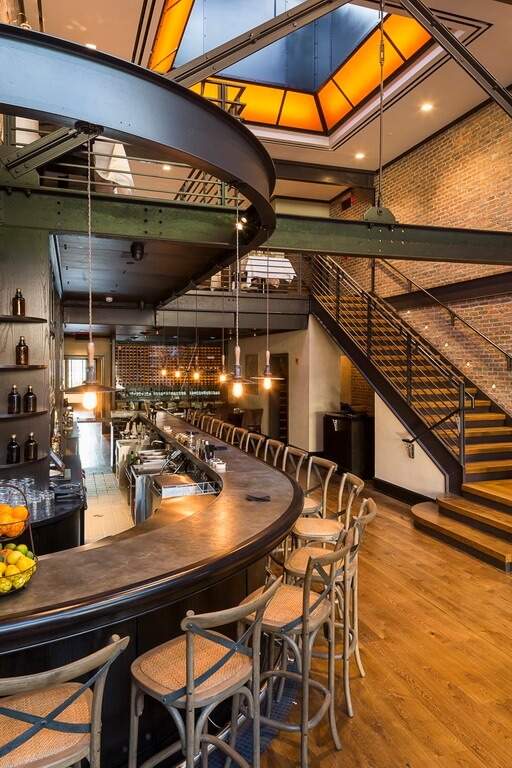
If you’re used to countertops that are supposed to look exactly the same in ten years as the day they were installed, zinc will surprise you. Zinc is a reactive metal with a living finish. It changes as you use it — and that change is not a flaw. It’s the reason people have put zinc on the counters of Parisian bistros, oyster bars and butler’s pantries for generations, and it’s the reason our customers choose it today.
Here is what to expect from a zinc top, from the day it leaves our shop in Mt. Kisco through the years that follow.
It starts out blue-gray
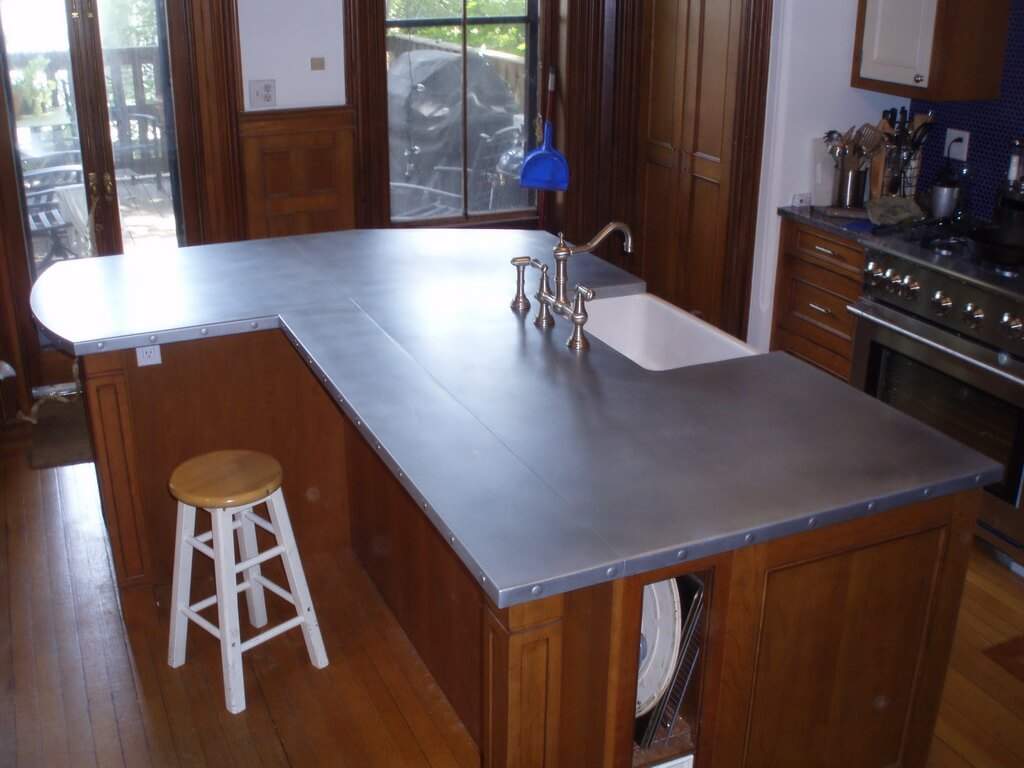
A new zinc countertop has a distinctive blue-gray hue — the cool tone of stainless steel, but warmer and softer in feel. Our tops are actual metal, with no coating over them, so what you see and touch is the zinc itself.
You should also expect the small marks of a handmade metal top: slight scratches, pinholes, soldering marks. They are part of the country charm of this rustic metal. On hammered and textured zinc, the surface will be wavy and undulated rather than machined flat. None of that is damage. It’s the character of the material, and it blends in as the patina develops.
The first year: the patina develops
Zinc reacts to air, water, and everyday use. Over time it develops a hazy-gray patina — a softened, lived-in surface that records how the counter is actually used. It may take up to a year for the full look to develop, and the patina never really stops: it continues to evolve throughout the life of the top, forming a pattern of use that can’t be intentionally recreated.
If you’d rather not start from bright metal, we can create a patina in our shop before installation. A shop-applied patina finish is darker than a natural patina and more even at first — but like a natural patina, it isn’t permanent or frozen. It will keep evolving and develop its own pattern of use in your kitchen.

Three finishes, three ways of aging
- Matte zinc is the finish most owners simply let age. Many choose to let the patina develop on its own, which enhances the industrial or country flavor of the top.
- Mirror-polished zinc starts bright and reflective. It can be kept up with a standard metal polish, and renewed with an automotive compound and a machine polishing pad when it dulls.
- Patina finish zinc arrives with its aged look already in place. The patina is a very thin layer with no protective coating over it, so this finish asks for a little more care — in return you get the finished look from day one, and it still keeps changing with use.
Living with it day to day
Zinc is easy to live with. For daily cleaning, Windex or mild soap and water is all you need — the same non-abrasive household cleaning you’d use anywhere in the kitchen. Wipe up liquids and spills promptly, use trivets under hot plates, and chop on a cutting board rather than the counter. Two hard rules: never use bleach, which reacts strongly with zinc and leaves marks; and keep in mind that acidic spills like lemon juice will lift the patina where they sit. If that happens, don’t panic — the patina grows back, in a new pattern.
On a matte top, light scratches and mineral streaking can be brushed out with a household 3M Scotch-Brite pad. Deeper scratches can be sanded out, working from 150 to 220 grit, then buffed with the Scotch-Brite pad in a circular pattern to recreate the original finish. White marks or rings scrub out lightly with diluted vinegar on a Scotch-Brite pad, followed by a rinse. On a patina finish, sanding or buffing will remove scratches — but it takes the patina with it, and the patina returns in a different pattern. That’s the honest trade of a living surface: it can be renewed, but it won’t be identical.
Is zinc right for your kitchen?
Choose zinc if you like the idea of a counter that looks better — and more yours — the longer you live with it. Every zinc top we make is designed and fabricated in our Mt. Kisco, NY shop, and you deal directly with the craftsmen and engineers building your top throughout the process. We’ve been a custom shop since 1977.
If you’re thinking about zinc — or you’d like to see what a developed patina actually looks like — call me at 914-954-6071. You’ll get me, Richard Brooks, not a call center. You can also reach us through the Contact Us page on this site and send photos or drawings of your project; we’ll review them and get back to you with a proposal.