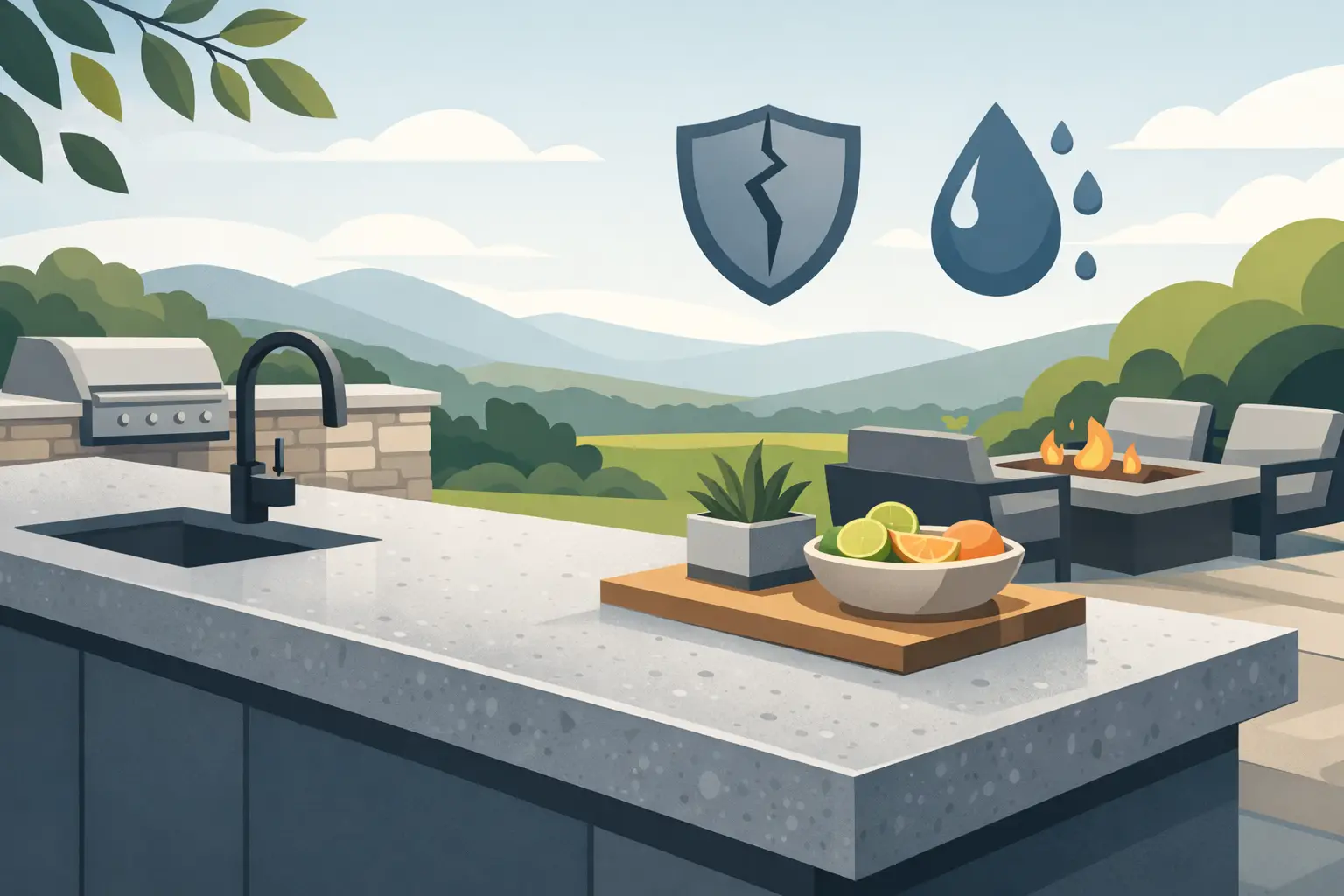
A backyard bar can look finished on installation day and tired two seasons later if its surface was not selected for the conditions it must face. The question, “are outdoor concrete countertops durable?” has a qualified but encouraging answer: yes, when the countertop is properly engineered, fabricated, supported, sealed, and cared for as an exterior architectural surface.
Concrete brings a depth and permanence that few outdoor materials can match. Its mineral character suits stone patios, cedar pergolas, painted brick, stainless grills, and contemporary pool settings equally well. Yet an outdoor countertop is exposed to more than dinner plates and drinks. It must live through direct sun, standing water, temperature swings, airborne debris, and, in many regions, repeated freeze-thaw cycles. Durable results depend on respecting those realities from the first design conversation.
What Makes Outdoor Concrete Countertops Durable?
Concrete is naturally strong in compression, which makes it well suited to a countertop that is fully supported on a properly built base. It is also noncombustible, substantial, and capable of being cast in tailored dimensions, profiles, colors, and edge details. For homeowners and designers who want a monolithic outdoor bar or kitchen surface made to exact needs, those qualities are compelling.
But concrete is not impervious by default. It contains microscopic pores, and it can develop hairline cracks as it cures, settles, or responds to thermal movement. Those characteristics are part of the material, not necessarily evidence of a fabrication failure. The goal is not to promise a surface that never changes. It is to create a well-made piece with the right mix design, reinforcement, sealing system, support, and detailing for its environment.
The most durable outdoor concrete work begins with a fabricator who understands the difference between an indoor vanity top and an exposed exterior installation. This includes selecting materials and construction methods that manage weight and strength without sacrificing the refined finish expected in a custom entertaining space.
Reinforcement and thickness matter
A large countertop must carry its own weight as well as the demands of daily use. Reinforcement helps control cracking and provides strength where a slab is most vulnerable, including around sink cutouts, overhangs, corners, and long spans. Depending on the design, a fabricator may use steel reinforcement, fiber reinforcement, or engineered concrete systems designed to achieve high strength at a more manageable weight.
Thickness should be considered alongside the supporting cabinetry or masonry base. A dramatic, thick-profile edge can be created without treating every inch of the piece as a solid mass of concrete. That opens more design freedom while keeping installation practical. The right approach depends on the countertop’s size, whether it includes an overhang for seating, and the structure below it.
A quality sealer does real work
Sealing is one of the most important protections an outdoor concrete countertop receives. A suitable exterior-grade sealer reduces water absorption and helps resist stains from oil, wine, citrus, sauces, and leaves. It also makes routine cleanup easier, preserving the intended color and finish.
No sealer makes a countertop maintenance-free. Outdoor exposure is demanding, and protective performance will gradually diminish with weather, cleaning habits, and use. A professionally made countertop should be paired with clear guidance on the type of sealer used, the products safe for cleaning, and the expected schedule for resealing. That is practical stewardship, not a drawback of choosing an authentic material.
Weather Is the Real Test
Sun, water, and temperature changes affect every outdoor surface. Concrete simply shows those forces in its own way.
In hot, sunny settings, ultraviolet exposure can alter the appearance of some sealers over time, particularly on darker colors or high-gloss finishes. A matte or low-sheen finish often feels more natural outdoors and can make minor signs of use less noticeable. Light-colored concrete may remain cooler under intense sun, while deep charcoal or black surfaces can become quite warm to the touch.
Rain creates a different concern. Water should drain away from the countertop rather than sit along a backsplash, sink rim, grill cutout, or seam. Thoughtful fabrication includes small details that make a meaningful difference: a slight slope where appropriate, carefully planned cutouts, and clean transitions to adjacent materials. A covered outdoor kitchen gains another layer of protection, but even a roofed countertop can be exposed to wind-driven rain and humidity.
For homes in the Northeast and other cold-weather regions, freeze-thaw resistance deserves particular attention. Water that enters pores or small cracks can expand as it freezes, increasing stress within the material. A dense, well-cured concrete mix and a maintained sealer help limit moisture entry. Just as important, avoid allowing water to pool on the surface or collect at edges through the winter. If a countertop will be left uncovered, seasonal cleaning and inspection should be part of the ownership plan.
Design Details That Protect the Surface
An outdoor countertop should be designed as part of the entire kitchen, bar, or dining setting rather than as a slab placed on top at the end. The best-looking installations are also usually the best considered.
A grill opening needs adequate clearance and support, with the appliance manufacturer’s specifications guiding the design. Sink cutouts and faucets need careful coordination before fabrication. A countertop that meets stone, tile, metal, or wood should have intentional joints that accommodate movement rather than force unlike materials to behave the same way.
Overhangs require special care. A modest seating overhang may be feasible with the right reinforcement, while a deeper cantilever may need concealed brackets or a structural support system. It is always better to resolve this in the design phase than to compromise the countertop after it arrives.
Color and finish are also performance decisions. A honed, lightly textured, or matte concrete surface can be especially forgiving in a hardworking outdoor setting. High-polish finishes can be striking, but they may reveal water spots, fingerprints, and fine surface wear more readily. Samples viewed outdoors are invaluable because sunlight can change the perceived color and movement of concrete dramatically.
What to Expect From a Living Material
Concrete is ideal for clients who appreciate material authenticity. Small variations in tone, subtle mottling, pinholes, and occasional hairline cracks can occur even in carefully controlled fabrication. These are often part of the hand-crafted character that distinguishes custom concrete from a uniform manufactured slab.
That said, expectations should be specific. Decorative pinholes are different from cracks that widen, collect water, or indicate inadequate support. Surface patina is different from staining caused by neglected spills. A trusted custom fabricator will explain what is inherent to the material, what can be controlled through finish selection and sealing, and what conditions require attention after installation.
For commercial hospitality spaces, the same conversation becomes even more important. An outdoor bar top may face constant glasses, food service, cleaning cycles, and customer traffic. In that setting, selecting the proper finish and establishing an ongoing care routine are as essential as choosing the shape or color.
Care That Keeps Concrete Looking Its Best
Routine care is straightforward. Wipe spills in a timely manner, particularly oils, acidic foods, red wine, and strongly colored ingredients. Use a soft cloth or sponge with a mild, pH-neutral cleaner, then rinse and dry the surface rather than leaving cleaner residue behind. Avoid harsh acidic products, abrasive powders, and aggressive scouring pads that can dull or weaken the sealer.
A few seasonal habits go a long way. Clear leaves and debris before they stay wet against the countertop. Check around seams, fixtures, and cutouts for standing water. Before winter, clean the surface thoroughly and assess whether water is still beading as expected. If the protective layer is wearing down, arrange for the appropriate resealing rather than waiting for a stain to reveal the problem.
When possible, use a fitted cover for the outdoor kitchen during long periods of nonuse, particularly in severe winter weather. The cover should allow air circulation and should not trap moisture directly against the countertop.
Is Concrete Right for Your Outdoor Project?
Concrete is an excellent choice when you want a custom surface with architectural presence, tailored proportions, and a finish that becomes more personal with use. It is especially effective for outdoor bars, poolside serving areas, built-in kitchens, and dining tables where a one-of-a-kind profile can anchor the whole setting.
It may not be the right fit if you expect a perfectly uniform appearance with no natural variation, or if you are unwilling to maintain a sealed exterior surface. In those cases, another material may better match your expectations. The right decision is less about choosing the toughest material in isolation and more about matching the material to the way you live, entertain, and care for your space.
At Brooks Custom, each made-to-order surface begins with those practical questions as well as the visual ones. A well-designed concrete countertop does more than withstand the outdoors. It gives your patio, terrace, or backyard kitchen a lasting center for the moments people remember there.