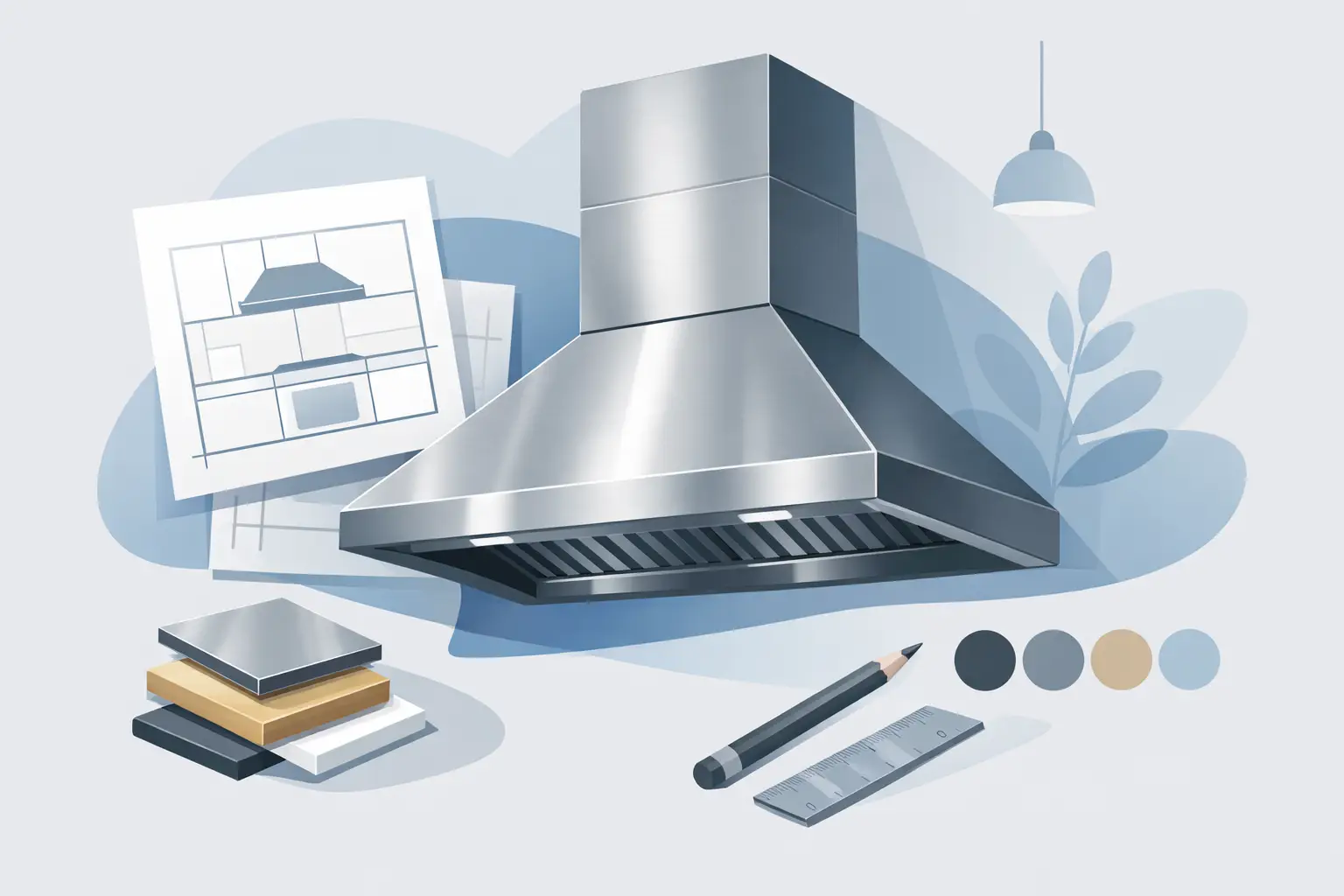
A range hood is often one of the first elements the eye lands on in a kitchen. A stainless steel hood surround gives that focal point a more intentional presence, concealing the working ventilation components behind a made-to-order exterior that fits the room, the cabinetry, and the way the kitchen is used.
For a serious home cook, it can bring a professional note to a high-performance range. For a designer, it creates a clean architectural anchor between upper cabinets, open shelving, stone, or tile. The difference is in the proportions. A custom surround is not simply a sheet-metal box placed above the cooktop. It is a fabricated feature designed around the exact hood insert, ceiling height, venting path, and visual character of the space.
What a Stainless Steel Hood Surround Does
The surround is the visible shell of the range hood. It typically covers a hood liner or insert, which contains the blower, filters, lights, and controls responsible for moving smoke, steam, heat, and cooking odors out of the kitchen or through a recirculating system.
This distinction matters during planning. The surround establishes the appearance and finished dimensions, while the insert handles ventilation performance. Both need to be selected with care, and both need to work together. A beautifully fabricated hood surround cannot compensate for an undersized blower, improper ductwork, or an insert that does not fit its interior cavity.
Stainless steel is a natural choice for this application because it is nonporous, heat tolerant, and practical to clean. It also brings a crisp, tailored finish that works equally well in transitional, contemporary, industrial, and classic kitchens. Depending on the design, it can feel quietly integrated with surrounding appliances or become a deliberate statement piece above the range.
Why Custom Proportions Make the Difference
Standard range hoods are made for common cabinet widths and typical ceiling heights. That can be enough for a straightforward kitchen, but it often leaves visual compromises in a carefully designed space. The hood may stop short of the ceiling, feel too narrow over a large range, or sit awkwardly between custom cabinets.
A custom stainless steel hood surround can be sized to the exact width of the cooking surface and given the right depth, chimney height, and lower skirt dimension. In many kitchens, the hood should extend beyond the range on each side to better capture cooking effluent and create a balanced silhouette. The right amount of extension depends on the hood insert, local code requirements, and the cooking equipment beneath it.
Scale is particularly important with 36-, 48-, and 60-inch ranges. A narrow, shallow hood over a substantial range can make the entire wall feel undersized. Conversely, an oversized surround in a compact kitchen may dominate the room. The best design considers the range, nearby cabinets, ceiling line, island or perimeter layout, and the sightlines from adjacent living areas.
Custom fabrication also makes room for details that give a hood its character: a straight or curved front, a tapered chimney, a deep lower band, wrapped corners, decorative straps, rivets, or a shelf-like ledge. These details should support the kitchen’s larger material story rather than compete with it.
Choosing the Right Stainless Steel Construction
Gauge, Seams, and Edges
The quality of a metal hood surround is visible in its fabrication. Heavier-gauge stainless steel offers a more substantial feel and is less prone to oil-canning, the wavy distortion sometimes seen across thin metal panels. The best gauge depends on the hood’s size, construction, and design details, but the material should feel properly supported rather than flimsy.
Seam placement deserves equal attention. Cleanly welded and finished corners create a more continuous appearance, especially on a large wall-mounted hood where every surface is in view. Folded edges, hemmed returns, and reinforced internal framing contribute to a crisp finished profile while eliminating sharp exposed metal.
For kitchens with a large exposed hood, ask how the front and side panels will be joined, where seams will appear, and whether the design calls for a single broad face or separately fabricated sections. Those decisions affect both the final look and the installation process.
Finish and Grain Direction
Most stainless steel hoods are finished with a brushed or satin grain. This soft linear texture is forgiving in an active kitchen and coordinates well with stainless appliances without appearing overly shiny. Grain direction should remain consistent across visible panels. It is a small detail, but misaligned grain can be surprisingly noticeable in daylight or under decorative lighting.
A polished finish has more reflectivity and can add glamour, particularly in a bar or hospitality setting. It also reveals fingerprints, water marks, and scratches more readily. For most residential kitchens, a brushed finish offers the more practical balance of refinement and everyday care.
Shape and Style
A simple box-style surround suits modern cabinetry, slab doors, and clean-lined stone. A tapered form can soften the wall and add a traditional or European influence. A curved front introduces a hand-crafted quality that pairs beautifully with plaster, warm wood, or natural stone.
Stainless steel does not require an all-metal kitchen. It can provide a disciplined counterpoint to wide-plank wood cabinetry, painted millwork, handmade tile, bronze hardware, or a richly veined backsplash. The material is adaptable, but the finish and shape should be chosen with the whole room in mind.
Plan the Surround Around Ventilation First
Ventilation requirements should guide the fabrication, not be treated as an afterthought. Before finalizing the surround dimensions, confirm the exact insert model, its required mounting height, electrical needs, duct location, and access points for filters and service. If the insert vents outdoors, the duct route and size need to be coordinated with the builder or mechanical contractor early in the project.
The cooking style matters as well. A powerful gas range, wok cooking, griddle use, or frequent high-heat searing generally calls for more capture capacity than a lightly used electric cooktop. Higher airflow can also introduce more sound, so the blower location and duct configuration deserve discussion. An external or inline blower may reduce noise at the cooking area, although it adds complexity to the installation.
A recirculating hood can be useful where exterior venting is not possible, but it is not equivalent to ducting cooking byproducts outdoors. In a new build or major renovation, exterior ventilation is usually the stronger long-term choice when the architecture allows it.
Coordinate the Surround With Its Surroundings
The hood does not exist alone. Its relationship to the backsplash is one of the most important design decisions on the wall. Some kitchens run tile or stone continuously behind and around the hood, allowing the metal form to stand forward from a textured field. Others use a stainless backsplash that meets the hood for a unified, restaurant-inspired surface that is easy to wipe down.
There are trade-offs. A full stainless wall can feel striking and purposeful, but it may be too cool for a kitchen that already has stainless cabinetry and appliances. Stone behind the hood introduces warmth and variation, although it requires careful layout so veins, seams, and cut edges remain balanced around the centerline.
Cabinet spacing also requires precision. If upper cabinets flank the hood, their heights and widths should be established before fabrication. If the hood reaches the ceiling, confirm whether crown molding, ceiling beams, or uneven conditions need to be accommodated. Made-to-order work is valuable precisely because these real-world details can be addressed rather than hidden behind a generic fit.
Care That Preserves the Finish
Stainless steel is durable, not maintenance-free. Regular cleaning with a soft cloth, warm water, and mild dish soap removes cooking film before it becomes difficult to lift. Dry the surface afterward to reduce water spotting, and wipe with the grain rather than across it.
Avoid steel wool, abrasive powders, harsh scouring pads, and chlorine-based cleaners. They can scratch the finish or cause surface damage. Degreasing is especially important around the lower lip and near the filters, where airborne oil naturally collects. With ordinary care, a quality stainless steel surround develops a clean, enduring appearance suited to a kitchen that is used often.
A Statement Piece Built for Real Use
A custom hood surround is the right choice when the kitchen calls for more than a standard appliance cover. It is particularly effective where dimensions are unusual, the range is substantial, the ceiling is high, or the hood needs to tie together several considered materials. It also gives designers and homeowners control over the details that make a finished room feel resolved.
At Brooks Custom, each hood can be fabricated around the specifications of the project, from straightforward brushed stainless forms to more detailed architectural designs. Begin with the ventilation insert and the kitchen’s measured conditions, then let the finished metalwork give the cooking wall the presence it deserves.