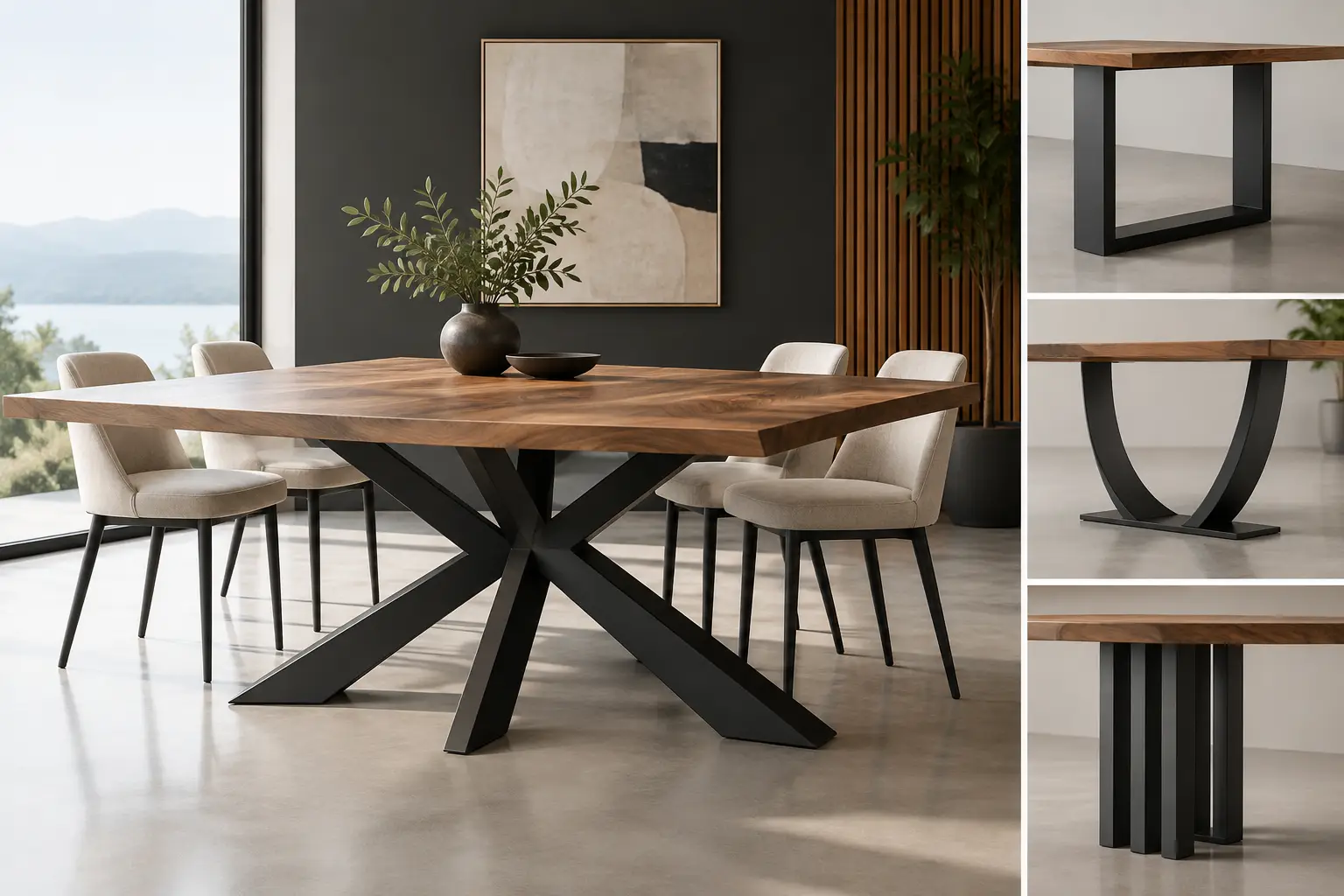
A table can have a remarkable top and still feel unfinished if its support is an afterthought. Custom metal table bases give a dining table, communal bar table, or hospitality piece the proportion, visual weight, and daily strength it needs to become a complete design statement.
For a home with a live-edge wood slab, a restaurant built around a zinc bar, or a conference room centered on a substantial tabletop, the base determines much more than the silhouette. It affects legroom, chair placement, stability, and how the entire piece relates to the room. A made-to-order metal base gives those decisions the attention they deserve.
Why Custom Metal Table Bases Change the Whole Piece
Metal introduces a purposeful contrast beneath wood, glass, concrete, or artisan-cast surfaces. Its clean lines can make a thick walnut top feel lighter. Its darker finish can ground a pale wood tabletop in an airy dining room. With a metal top, the relationship can become more tonal and architectural, allowing form, edge detail, and finish to carry the design.
More importantly, custom fabrication lets the base follow the actual tabletop rather than forcing the tabletop to conform to a standard footprint. A long dining table may need supports positioned to preserve comfortable seating at both ends. A round top may call for a central pedestal that keeps every chair free of corner legs. A large commercial table may require a structure engineered for frequent use without making the room feel heavy.
The right answer depends on the top material, dimensions, intended use, and the experience you want around the table. There is no single “best” base style. There is only the base that is properly considered for the piece.
Start With the Tabletop, Not the Trend
A popular base profile can look entirely different once it is paired with a particular surface. Before choosing a shape, begin with the tabletop itself: its length, width, thickness, edge treatment, material, and visual character.
A thick, wide-plank wood top has a natural presence. It can carry a strong, angular base with ease, particularly in a contemporary kitchen or dining room. A thinner glass top often benefits from a base that creates visual openness while providing support where the glass needs it. Engineered concrete may call for a more substantial base designed around its weight and scale.
The top’s overhang matters as well. An overhang gives diners room for their knees and allows a table to appear more refined, but too much unsupported span can compromise the feel and performance of the piece. With custom work, the base can be sized and positioned to balance clean proportion with dependable support.
For commercial tables, this conversation becomes even more specific. A busy café or restaurant needs a base that supports the surface securely, accommodates the seating plan, and holds up to the movement of everyday service. A beautiful table should never become an obstacle for guests or staff.
Consider how people will use the table
A dining table used for family meals, homework, and entertaining has different requirements from a standing-height cocktail table or a row of two-top restaurant tables. Think about the chair count, whether seating will extend at the ends, and whether stools need foot clearance. These details often determine whether a pedestal, trestle, or leg-style base is the better choice.
Choosing a Base Style That Fits the Room
The best base styles feel intentional without competing with the tabletop or surrounding architecture. They should repeat or complement the room’s existing language, whether that means quiet minimalism, classic craftsmanship, industrial character, or a more sculptural point of view.
A pedestal base is especially effective beneath round and square tops. Because it keeps the perimeter clear, it allows flexible seating and gives smaller dining areas a more open feel. The pedestal itself can be restrained and architectural or more expressive, depending on the room.
Trestle bases work beautifully with long rectangular tables. Their supports are set inward from the ends, which can preserve end seating while creating a substantial, furniture-like presence. They are a natural pairing for generous wood slabs, butcher block tops, and large gathering tables.
A leg-style base can offer a lighter, more familiar profile. Straight legs suit clean-lined interiors, while angled or tapered forms bring movement and a modern edge. For a table where chair placement is the priority, the spacing and inset of each leg deserve careful attention.
Sled and U-shaped bases deliver a clear graphic profile, often well suited to contemporary interiors and communal tables. Their continuous linear form can echo window frames, shelving, or exposed steel features elsewhere in the space. They work best when the width of the base and the top overhang are thoughtfully balanced.
Scale Is Where Craftsmanship Shows
A base may be structurally sound and still look wrong. When the supports are too narrow for a broad top, the table can appear top-heavy. When the metal members are oversized for a delicate surface, the piece can feel unnecessarily severe. Custom proportions are what allow materials with very different visual weights to belong together.
Height is another essential dimension. Standard dining tables generally need to work with standard dining chairs, while counter-height and bar-height tables require a different relationship between the top, stools, and floor. The thickness of the tabletop changes the finished height, so it must be part of the calculation from the beginning.
At Brooks Custom, this level of coordination is central to made-to-order work. A base is not treated as a separate accessory. It is considered alongside the surface material, finish, edge profile, and intended setting to create a piece that feels cohesive from every angle.
Finish Should Support the Material Story
Metal is not limited to one look. Its finish can shift a table from crisp and contemporary to warm, aged, or quietly industrial. The right choice often comes down to the materials already present in the space.
Darkened or blackened metal can create contrast beneath light oak, maple, or pale concrete. A warmer bronze, copper, or pewter direction can relate beautifully to wood tones, decorative hardware, and ambient lighting. Stainless steel offers a cleaner, more modern note, particularly where its durability and bright surface suit the setting.
Patina and variation deserve consideration before they are specified. Some finishes are valued precisely because they carry tonal movement and character. Others are selected for a more uniform, controlled appearance. Neither approach is better, but expectations should be clear. A handcrafted metal finish has depth that a flat, factory-applied color cannot replicate.
For a mixed-material table, repetition creates harmony. A metal base might pick up the tone of a range hood, bar rail, pendant detail, or architectural hardware. Even a subtle connection can make the room feel more resolved.
Plan for Real-World Performance
A table base needs to live well, not simply photograph well. Dining tables endure shifting chairs, moved place settings, children leaning into corners, and years of gatherings. Commercial tables face even more frequent contact and cleaning. Structural design, joinery, and material thickness should reflect that reality.
Floor conditions also matter. An old wood floor, stone tile, and polished concrete surface do not behave the same way. A well-considered base accounts for stable contact points and helps the table sit confidently in its final setting. For larger surfaces, internal support and attachment details may be necessary to keep the top properly supported over time.
Material movement is another practical concern, especially with solid wood. Wood responds naturally to changes in its environment, while metal responds differently. The relationship between the base and top should allow each material to perform as intended without creating unnecessary stress on the finished piece.
A Better Way to Specify a Custom Base
The most successful custom projects begin with a clear picture of how the table will be used and where it will live. Start with the finished tabletop dimensions, desired height, seating plan, and room measurements. Then consider the top material and weight, the preferred base profile, and the finish direction.
Photos of the surrounding space can be useful when selecting a metal tone or silhouette. So can material samples, particularly when pairing metal with wood, concrete, glass, or another metal surface. A sample lets you assess warmth, texture, and contrast in the actual light of the room rather than relying on a screen.
Be open to refinement. A small change in the width of a pedestal, the placement of a trestle support, or the thickness of a metal member can improve both the comfort and appearance of the finished table. That is the advantage of fabrication made to your exact needs: the final details can serve the design instead of being dictated by a stock component.
A well-made table invites people to stay longer. Choose a custom metal base with the same care you give the surface above it, and the finished piece will bring lasting presence to every meal, meeting, and gathering.