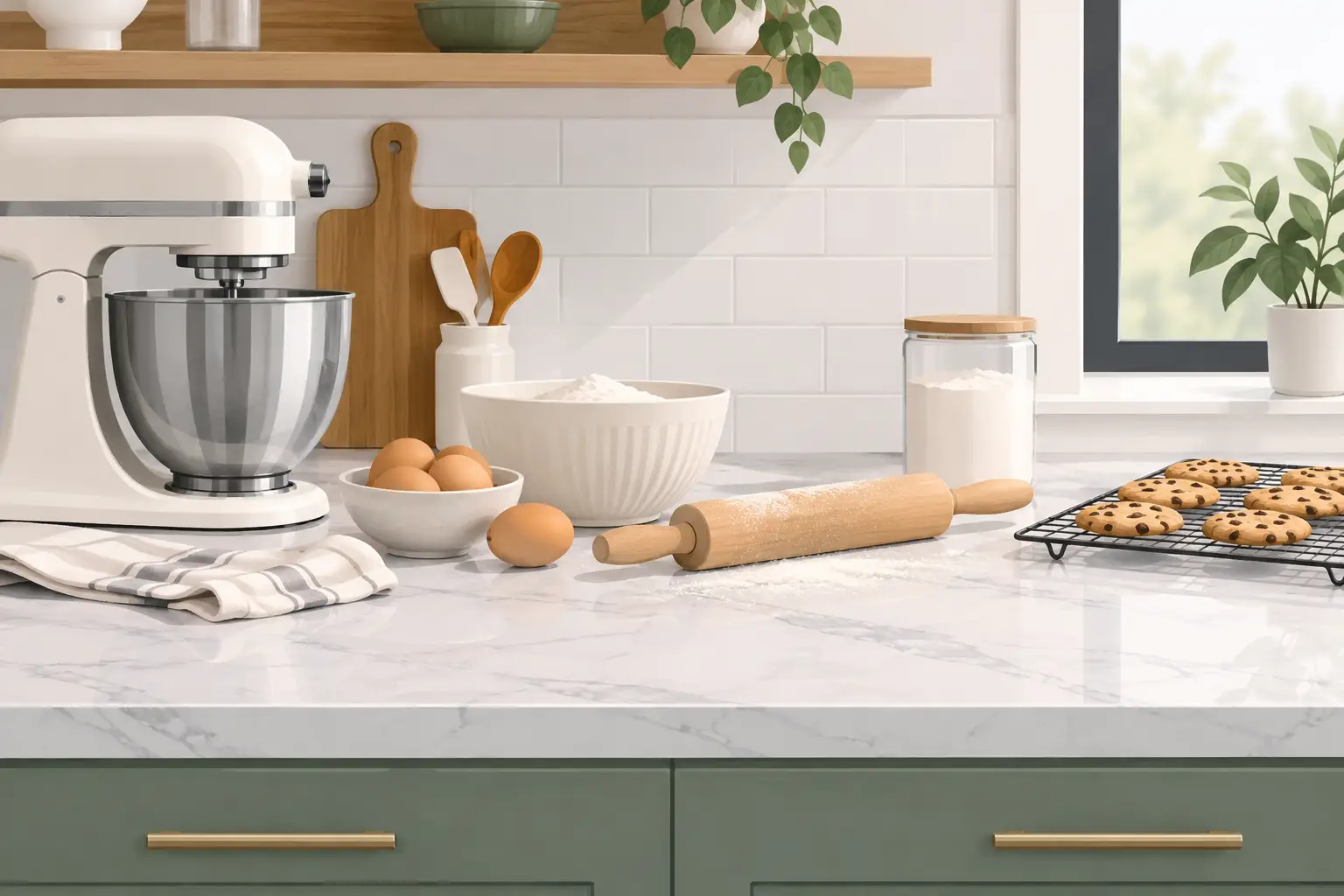
A countertop can change the way baking feels. The right surface gives pie dough a cool place to rest, stands up to flour, sugar, and citrus, and looks at home when the mixer stays out all weekend. The best countertop materials for bakers are not all the same because a bread baker, a pastry enthusiast, and a frequent entertainer each ask different things of a kitchen.
For many homes, the strongest choice is a thoughtful mix of materials rather than one surface used everywhere. A cool stone-like prep area beside a warm wood island, for example, can support precise pastry work while giving the room a more personal, collected character.
What Bakers Need From a Countertop
Baking puts a surface through a particular kind of work. Rolling pins, bench scrapers, heavy stand mixers, sticky dough, food coloring, hot pans, and long cleanup sessions all leave their mark. Before choosing a material, consider how you bake most often and how much visible patina you welcome.
Temperature is often the first consideration. Butter-rich doughs and laminated pastries are easier to manage on a naturally cool surface. Bread and pizza makers may prioritize a generous, durable work area that can handle kneading and repeated impact. For households that bake with children or entertain often, easy cleanup and stain resistance may carry more weight than a pastry-perfect chill.
The visual side matters, too. Baking is tactile and generous, and the countertop should suit that spirit. A hand-finished wood top can make a kitchen feel immediately inviting. Metal brings a more tailored, professional edge. Engineered concrete offers quiet depth and architectural presence.
Best Countertop Materials for Bakers, Compared
Marble for pastry precision
Marble has earned its reputation with pastry cooks for a reason. Its naturally cool surface helps keep butter firm while rolling pie crust, shortbread, biscuits, puff pastry, and fondant. It also offers a smooth, firm plane that makes shaping dough feel controlled and exact.
The trade-off is that marble is not carefree. Acidic ingredients such as lemon juice, berries, vinegar, and wine can etch its surface, while deeply colored ingredients may leave stains if not addressed promptly. Bakers who love marble tend to appreciate its developing character, or reserve it for a dedicated baking center rather than relying on it throughout the entire kitchen.
A marble slab or inset work zone can be especially effective when it is sized around the sheet pans, rolling pins, and mixing bowls you use most. This approach delivers the performance pastry demands without asking the material to absorb every task in a busy kitchen.
Butcher block and wide-plank wood for warmth
Wood is the material that makes a kitchen feel lived in before the first loaf comes out of the oven. Butcher block and wide-plank wood surfaces are comfortable for kneading bread, shaping cookies, and setting out cooling racks. They also soften the visual hardness of cabinetry, stone, and appliances.
A quality wood countertop should be made for the way it will be used. Species, grain orientation, edge details, thickness, and finish all influence its final look and performance. A durable protective finish can make wood far more practical for daily kitchen work while preserving the natural movement and richness that make each board distinct.
Wood does require attentive care. Standing water should be wiped up, sharp knives can leave marks, and high heat calls for a trivet. Yet small marks are often part of its appeal. Unlike a uniform manufactured surface, wood can age gracefully, developing a patina that records years of meals and baking projects.
Stainless steel for serious daily use
Stainless steel brings commercial-kitchen utility into a residential setting. It is nonporous, easy to clean, resistant to heat, and exceptionally well suited to frequent baking. Sticky dough, melted chocolate, and flour dust wipe away without much ceremony, and its cool feel is useful when working with pastry.
It is also a compelling choice for bakers who prefer a crisp, minimal kitchen or want a strong contrast beside natural wood. A stainless baking station can feel purposeful without making the whole room look industrial, particularly when paired with warm cabinetry or a wood-topped island.
Scratches and small dents are the expected trade-off. Over time, stainless develops a brushed, working patina. For some owners, that evidence of use is precisely the point. For others, a less visibly reactive material may be a better fit.
Zinc, pewter, bronze, and copper for character
Craft metals offer a different kind of baking surface: expressive, hand-finished, and unmistakably individual. Zinc and pewter have a soft, silvery appearance that complements traditional, European-inspired, and transitional kitchens. Bronze and copper add warmth and depth, particularly in spaces designed around rich woods, painted cabinetry, or aged hardware.
These metals are best selected with an appreciation for patina. They can darken, lighten, and show subtle variations with use. That living finish gives a baking island or bar-height worktable an authenticity that cannot be duplicated by a printed pattern.
For food-prep areas, discuss the intended use and finish requirements early in the design process. Metal can be an excellent accent surface, a baking table top, or a statement island, but the right material and protective approach depend on whether the area will see daily food preparation, serving, or lighter-duty use.
Engineered concrete for tailored performance
Engineered concrete has a grounded, architectural quality that works beautifully in custom kitchens. It can be made in a broad range of tones, from pale limestone-inspired neutrals to deep charcoal, and its proportions can be tailored to create a substantial island or baking table.
For bakers, its appeal lies in its solidity and visual calm. It offers a stable work surface for mixers and kneading, while its handmade character gives the room more depth than a standardized slab. Depending on the formulation and finish, it may also provide a cooler working surface than wood.
Concrete is not a maintenance-free material. It needs an appropriate sealer and reasonable care around acidic spills, oils, and high-impact edges. Hairline variation and subtle tonal movement are natural parts of its character. Choose it when you want the countertop itself to feel like a crafted architectural element, not simply a background finish.
Glass for a clean, light-filled baking station
Specialty glass is an unexpected but refined option for a smaller baking area, buffet, or worktable. Its nonporous surface cleans easily, reflects light, and can be customized for color, texture, and opacity. In a darker kitchen, glass can make a dedicated prep area feel open and luminous.
It is less conventional for a primary, hard-working baking counter than wood, marble, or stainless steel. Still, glass can be a beautiful supporting surface where presentation, easy cleanup, and a distinctive visual statement are central to the design.
Build the Kitchen Around How You Bake
The best choice often becomes clearer when you stop asking which material is universally best and start asking where each task happens. If you make croissants and pie crust every week, place a cool marble or stainless surface near the refrigerator and ingredient storage. If sourdough is your ritual, a broad wood-topped island gives you room to knead, score, and serve.
Consider the scale of your tools as well. A stand mixer needs a stable surface and enough clearance for lifting bowls and attachments. Sheet pans need landing space near the oven. A 24-inch-deep counter may be sufficient for simple prep, while a larger island can support rolling, mixing, cooling, and conversation at once.
A mixed-material design can make these needs feel intentional. Use wood where people gather, metal where cleanup is constant, and marble where pastry benefits from cool control. The transition between materials can become a design feature rather than a compromise.
Details That Make a Custom Surface Work Harder
Material is only part of the decision. Edge profiles, thickness, corners, and finish selection affect both daily comfort and long-term appearance. A softened edge is gentler when you lean into dough. A substantial wood thickness can make an island feel furniture-like. A carefully chosen metal patina can connect a countertop to a range hood, shelving, or hardware.
Samples are valuable because materials change with light. View them near your cabinetry, flooring, and backsplash, then think beyond appearance. Touch the surface. Notice whether it feels cool, textured, formal, relaxed, or ready for use. The right countertop should make you want to pull out the flour.
Brooks Custom creates made-to-order wood, metal, engineered concrete, and glass surfaces for kitchens designed around real life. A material conversation can begin with a favorite recipe, a cabinet color, or simply the wish for a baking space that feels unlike anyone else’s.
Choose the surface that supports your favorite kind of baking and leaves room for the marks, memories, and meals that follow.