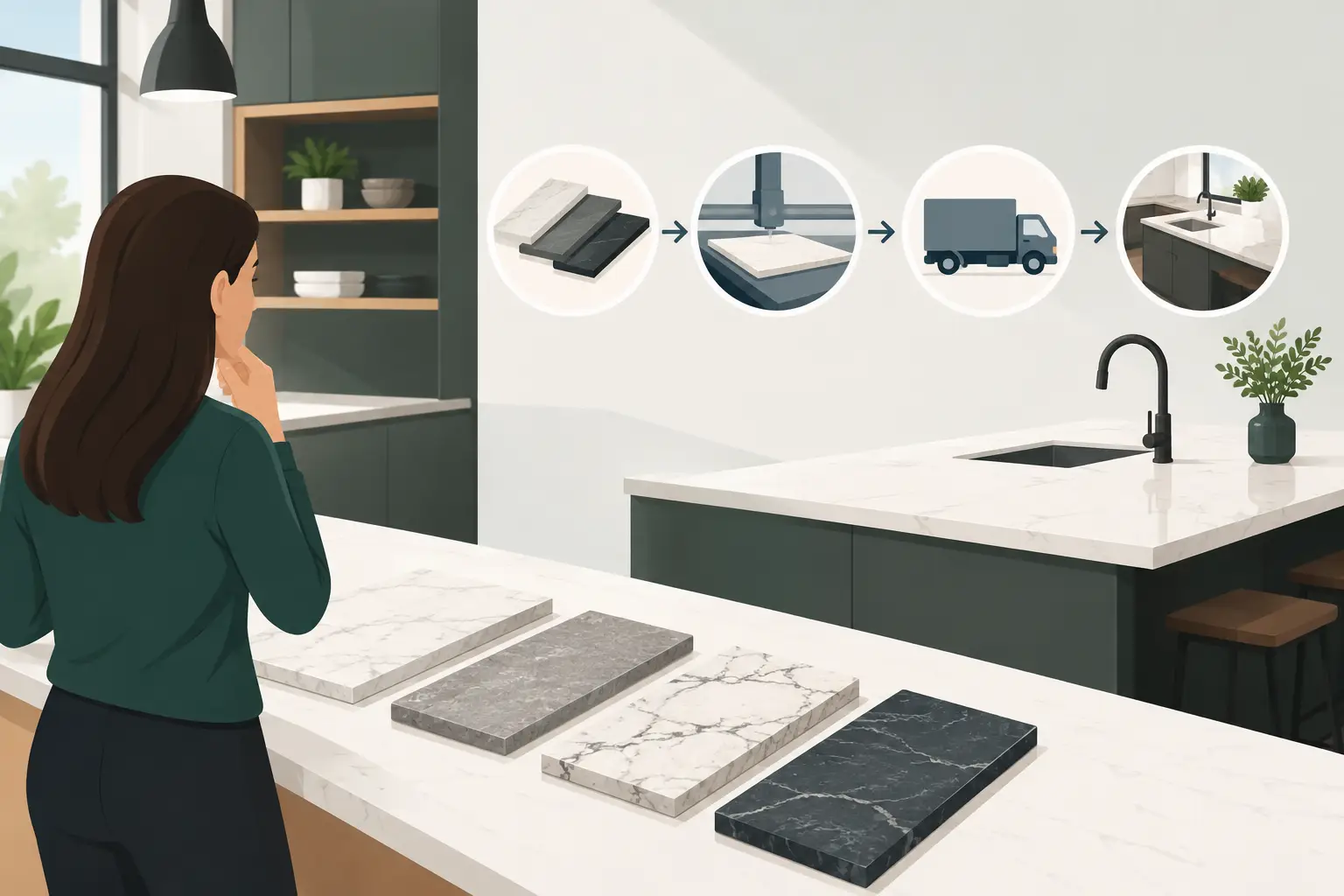
A custom surface is not pulled from a warehouse shelf. Its proportions, material character, edge details, finish, and construction are considered for one specific project. That is why custom countertop lead times are best understood as a careful production sequence, not simply a number on a calendar.
For a kitchen island in wide-plank wood, a zinc bar top for a restaurant, or a cast-metal statement surface, the right lead time protects the quality of the finished piece. It gives the material and the maker the attention required to create something enduring, distinctive, and made to your exact needs.
What Shapes Custom Countertop Lead Times?
The material is often the first factor. Wood, metal, engineered concrete, and specialty glass each require a different fabrication process, as well as different finishing, curing, inspection, and packing considerations. A straightforward rectangular butcher block top may move through production differently than a large live-edge slab with a custom profile or a layered metal bar top with integrated details.
Dimensions matter, too. Larger pieces may require additional planning for grain layout, seam placement where appropriate, reinforcement, crating, and freight handling. This does not make a larger surface less achievable. It simply means that scale is part of the fabrication conversation from the beginning.
The level of customization also affects timing. A selected standard profile and finish can be confirmed more quickly than a piece with several custom elements. Unique edge treatments, decorative metalwork, unusual shapes, matched components, or multiple surfaces for one room all deserve adequate time for review and coordinated production.
For commercial projects, the quantity and consistency requirements can be just as significant as the individual design. Restaurant tables, bar tops, host stands, and guest-facing counters must look intentional across the space while standing up to daily use. Production scheduling accounts for that consistency.
The Production Stages Behind the Schedule
A lead time begins only after the essential project details are established. Clear specifications allow fabrication to proceed with confidence and help avoid revisions that can affect the schedule later.
Material Selection and Project Details
Material selection is more than choosing a color from a screen. Natural wood varies in grain, mineral streaking, knots, and movement. Hand-worked metals develop character through their surface treatment and patina. Specialty glass and engineered concrete have their own visual and structural considerations.
Samples are particularly useful when a project calls for a precise relationship between the surface and surrounding cabinetry, tile, flooring, upholstery, or lighting. They help set expectations for tone, texture, sheen, and variation before the piece enters fabrication.
At this stage, dimensions, thickness, edge preferences, finish selection, and any special features should be defined. The more complete the information, the more accurately a production window can be planned.
Fabrication and Hand Finishing
Once specifications are confirmed, the work becomes material-specific. Wood surfaces may be selected and laid out for the most compelling grain presentation before cutting, joining, sanding, and shaping. Live-edge pieces call for additional care because the natural perimeter is part of the design rather than a standardized edge.
Metal countertops and bar tops require a different kind of craftsmanship. Zinc, bronze, copper, pewter, and stainless steel can be formed, detailed, and finished to create a surface with depth and character. Depending on the design, hand-applied texture or patina work may add time, but it also creates the visual richness that makes custom metal so compelling.
Finishing is not an afterthought. It is one of the most meaningful stages for both appearance and performance. A durable protective finish can help a wood surface resist staining and stand up to everyday use, while preserving the tactile quality that makes real wood so appealing. Finishes need appropriate time to cure before a piece is packed and shipped.
Quality Review, Packaging, and Delivery
Before a custom surface leaves the shop, it is reviewed for craftsmanship, finish quality, dimensions, and overall presentation. This step is especially important for surfaces that will become a focal point – a dining table, a waterfall-style island component, a hospitality bar, or a custom range hood.
Packaging is planned around the material and the piece itself. A substantial solid-wood top, a metal surface with a hand-finished face, and a specialty glass component do not travel the same way. Proper protective packaging and crating are part of delivering a surface in the condition it deserves to arrive.
Delivery timing is then influenced by destination, shipment method, size, and freight coordination. For projects with a fixed renovation, opening, or event date, it is wise to account for delivery planning early rather than treating it as the final detail.
How to Keep Your Project Moving Forward
The simplest way to support predictable custom countertop lead times is to make key decisions early. Waiting to select a material until other finishes are already locked can narrow options and add pressure to the schedule. Starting with samples and a clear design direction gives the entire project a stronger foundation.
It also helps to distinguish between a desired date and a practical production date. If a space must be ready for a holiday gathering, restaurant opening, or seasonal move-in, work backward from that milestone. Include time for material selection, specification approval, fabrication, finishing, packaging, and delivery.
Avoid changing details after production is underway unless the improvement is worth the added time. A revised thickness, new edge profile, or shift from one material to another can require the project to be re-evaluated. That is not a flaw in the custom process. It is the reality of making a piece specifically for your space rather than selecting a standardized product.
For designers and builders managing several materials, a finish schedule can be helpful. Note the surface material, dimensions, color or finish direction, and target delivery date for each piece. This keeps countertops, tabletops, backsplashes, range hoods, and decorative wall components aligned with the broader design vision.
When a Longer Lead Time Is Worth It
A shorter timeline can be appropriate for a simpler design with readily available material options. But a longer lead time is often worthwhile when the surface is intended to define the room.
Consider a broad walnut island top with carefully selected grain, a hand-finished bronze bar surface, or a live-edge dining table built around the movement of a single slab. These are not interchangeable materials. Their variation, scale, and craftsmanship are the point.
The same is true for performance requirements. A busy family kitchen, a coffee bar, or a high-traffic hospitality setting may benefit from a finish and construction approach chosen for the way the surface will actually be used. Rushing that decision can mean compromising on the material or level of detail that made the custom piece appealing in the first place.
Plan Early, Then Let Craftsmanship Do Its Work
The best custom projects feel considered because they are considered. Establish the design direction, choose materials that suit both the room and the way it will be used, and allow realistic time for skilled fabrication.
Brooks Custom has spent nearly five decades creating made-to-order wood, metal, concrete, and glass surfaces for homes and commercial spaces. Whether your vision calls for a warm butcher block counter, a tailored metal bar top, or a one-of-a-kind tabletop, early planning gives craftsmanship the room to bring that vision to life.